
Credits: ARISS
ARISS Contact is Scheduled with Students with
NixderStelar, Lima, Peru
August 18, 2025—Amateur Radio on the International Space Station (ARISS) has received schedule confirmation for an ARISS radio contact between an astronaut aboard the International Space Station (ISS) and students with NixderStelar located in Lima, Peru. ARISS conducts 60-100 of these special amateur radio contacts each year between students around the globe and crew members with ham radio licenses aboard the ISS.
NixderStelar, formerly known as Gemini-1, is a Peruvian youth organization dedicated to transforming education through equitable access to science, technology, and space exploration. Its mission is to bring STEM education to underserved communities across the country. The organization leads workshops, talks, and innovative learning experiences that combine ancestral wisdom with modern science. It was founded by Niurka Leiva Panizo, a young Peruvian student who turned her experience at NASA into a national educational movement. Today, NixderStelar stands for hope, empowerment, and a generation of students in Peru who believe that space is also for them.
This will be a telebridge Contact via Amateur Radio allowing students to ask their questions of astronaut Zena Cardman, amateur radio call sign KJ5CMN. The downlink frequency for this contact is 145.800 MHz and may be heard by listeners that are within the ISS-footprint that also encompasses the telebridge station.
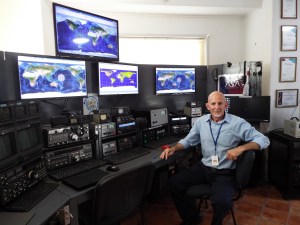
The ARISS amateur radio ground station (telebridge station) for this contact is in Glenden, Australia. The amateur radio volunteer team at the ground station will use the call sign VK4KHZ, to establish and maintain the ISS connection.
The ARISS radio contact is scheduled for August 20, 2025 at 9:08 am PET (Peru) (14:08 UTC, 10:08 am EDT, 9:08 am CDT, 8:08 am MDT, 7:08 am PDT).
_______________________________
As time allows, students will ask these questions:
- Do you think artificial intelligence could one day help in emergencies in space? How could it be trained without being dangerous?
- If you could leave a message for the youth of the future from space, what would it tell them about taking care of Earth and continuing to explore the universe?
- How do you think artificial intelligence is changing the way we understand the universe and ourselves as human beings?
- Have you ever felt like someone else, from another place in the universe, is watching you too? What have we learned up there that we should all know?
- How did your view of the world and life change after being in space? What would you say to those who dream of being astronauts from down here?
- Being away from home and your loved ones must be difficult. How do you handle the loneliness, confinement, and emotions of being in space?
- How did your outlook on life on Earth change after seeing it from so far away? How can we inspire others to care for the planet?
- What was the most unexpected moment that made you feel deeply human while you were up there?
- How does space radiation affect the brain and decisions? Are ways being sought to protect astronauts from this?
- Do you think we’re the ones exploring the universe, or is it the universe getting to know us through you?
- What do astronauts do on a typical day on the Space Station?
- From up there, has your view of Peru or Earth changed? Is there anything you value more now?
- After being in space, are there things on Earth that you no longer enjoy as much or that seem different to you?
- What experiments did you conduct on the station that could help solve problems on Earth, such as climate change or diseases?
- How do you protect yourself from the damage caused by microgravity, such as losing strength or not sleeping well? What technologies help you with this?
- How does the lack of gravity affect your daily life? Do you think we’ll one day be able to create artificial gravity in space?
- What physical or emotional effects have you or your colleagues felt from being in space or training for it?
- What skills or attitudes do you think a young person should have to become a good astronaut in the future?
- What important discoveries have you made from there? What things still remain unanswered?
- Have you ever felt like you lost track of where you were or became a little disconnected from your life on Earth?
About ARISS:
Amateur Radio on the International Space Station (ARISS) is a cooperative venture of international amateur radio societies and the space agencies that support the ISS. In the United States, sponsors are the American Radio Relay League (ARRL), Amateur Radio Digital Communications (ARDC), Radio Amateur Satellite Corporation (AMSAT), NASA’s Space Communications and Navigation program (SCaN) and the ISS National Lab—Space Station Explorers. The primary goal of ARISS is to promote exploration of science, technology, engineering, the arts, and mathematics topics. ARISS does this by organizing scheduled contacts via amateur radio between crew members aboard the ISS and students. Before and during these radio contacts, students, educators, parents, and communities take part in hands-on learning activities tied to space, space technologies, and amateur radio. For more information, see http://www.ariss.org.
Media Contact:
Dave Jordan, AA4KN
ARISS PR
Find us on social media at:
X: ARISS_Intl
Facebook: facebook.com/ARISSIntl
Instagram: ariss_intl
Mastodon: ariss_intl@mastodon.hams.social
Check out ARISS on Youtube.com.